
The idea of skin cancer feels daunting enough in itself. But what can you expect from basal cell skin cancer surgery near Bethesda, MD? Our expert surgeon, Dr. Brent Faulkner, can take some of the guesswork out of this stressful equation and ease your mind as you navigate these concerns.
Continue reading this blog to learn more about basal cell carcinoma and what your treatment with Dr. Faulkner might look like. If you’re ready to plan your skin cancer surgery with Faulkner Plastic Surgery & Aesthetics, contact our front desk or schedule a consultation online.
Understanding Basal Cell Carcinoma
Your skin is your armor, protecting you from environmental forces like bacteria, light, heat, and more. But what happens when that protective outer layer—your epidermis—develops cancer?
Basal cell carcinoma is a common form of skin cancer that develops in your basal cells, or the cells in the bottom layer of your epidermis. The basal cells in your epidermis produce keratin, melanin, and new skin cells, making that layer essential to your skin’s ability to heal and continue regenerating.
Causes
What causes basal cell carcinoma? Most basal cell skin cancer forms on parts of the body that are regularly exposed to UV light, like the head, face, and neck. However, sun damage is not always the culprit—some individuals have a family history of skin cancer or have immunodeficiencies that increase their chances of developing a carcinoma.
When a patient has basal cell carcinoma, the cancer cells alter the DNA of the skin’s basal cells, so the cancer cells multiply without the limited life cycle of the basal cells.
These cancer cells eventually overtake and destroy the healthy tissue, as the other basal cells can’t compete with those rates of production. Though basal cell carcinoma can spread to other parts of the body, this is rare.
Symptoms
Basal cell carcinoma manifests as new or changing growths or sores, also known as lesions. These lesions have one or more of the following characteristics:
- A shiny bump that’s the same color as your skin, but not fully opaque
- A blue, brown, or black lesion with a raised border
- A white, scar-like growth
- A flat, scaly patch
Diagnosis & Testing
Consistently evaluating your skin health aids early detection. That means keeping an eye out for new or changing skin growths and lesions, as these can indicate unusual cellular activity.
Undergoing Treatment
Once you have determined you have an abnormal growth, you will work with Dr. Faulkner to determine a course of treatment.
As a board-certified plastic surgeon with 20 years of experience, Dr. Faulkner prides himself on precise medical procedures and reconstructive excellence. When you schedule your basal cell skin cancer surgery near Bethesda, MD, you are in very capable hands.
Surgery Types
Regardless of the procedure type best suited to the size and placement of your carcinoma, Dr. Faulkner focuses on preserving your healthy tissue. Your options for basal cell skin cancer surgery near Bethesda include surgical excision and MOHS surgery.
Surgical Excision
Dr. Faulkner might recommend surgical excision for lesions on the hands, feet, or chest, as basal cell carcinoma is less likely to reform on skin with less direct UV exposure. During surgical excision, Dr. Faulkner removes the cancerous lesion and a margin of the surrounding healthy skin, examining the healthy tissue to confirm no cancer cells are present.
MOHS Surgery
MOHS surgery best fits patients with large lesions or growths on the face, as it enables deeper inspection while minimizing unnecessary tissue removal.
During MOHS surgery, a dermatologist precisely removes skin cancer by taking off thin layers of skin and checking each one under a microscope right away. The dermatologist repeats this process until no cancer cells remain. This approach leaves as much healthy skin as possible, especially in delicate areas like the face.
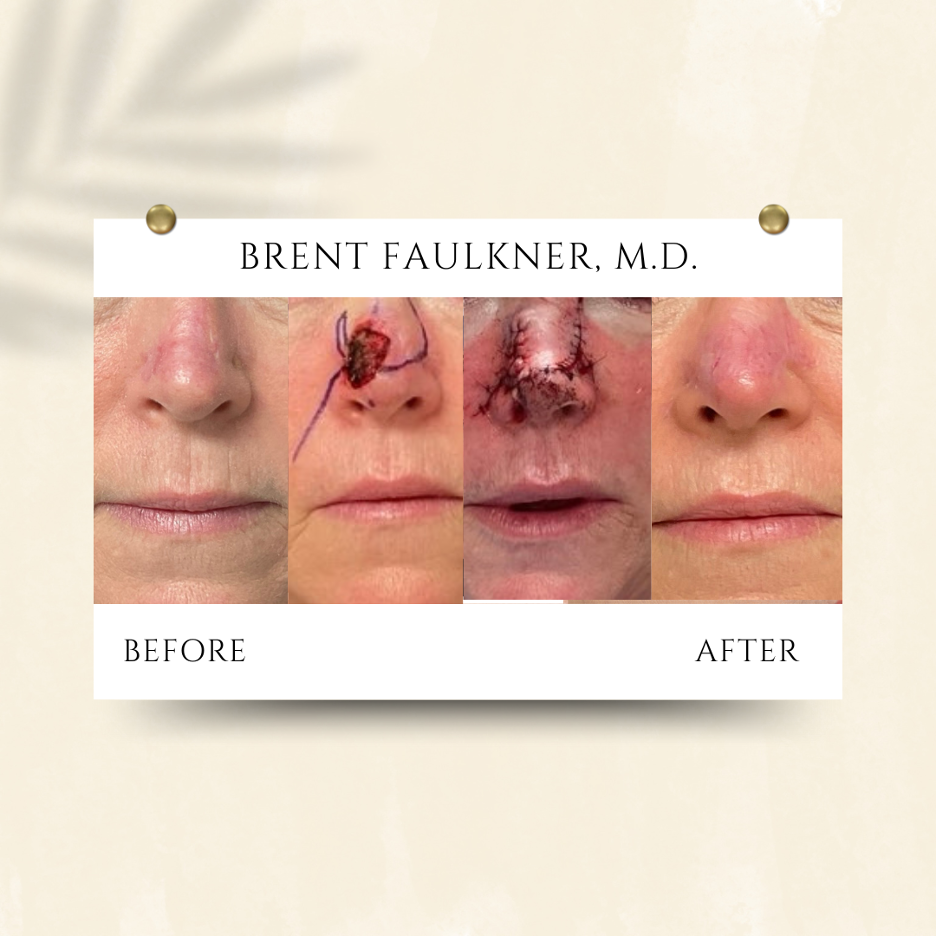
Once the dermatologist finishes removing the cancerous tissue, they send the patient to Dr. Faulkner for surgical closure. Patients often see a plastic surgeon after MOHS surgery because the wound can be in a delicate or highly visible area—like the face, nose, or eyelids—where appearance and function are critical.
Plastic surgeons like Dr. Faulkner specialize in advanced techniques (e.g., flaps, grafts, and precise stitching) that help the area heal with optimal cosmetic and functional results. The dermatologist removes all the cancer, and Dr. Faulkner focuses on making the repair look and heal as well as possible.
Caring for Your Skin
Following your basal cell skin cancer surgery near Bethesda, Dr. Faulkner provides a custom after-care plan to help guide your recovery.
As with any wound, and especially after a procedure on the face, head, or neck, you must protect your healing skin from sun exposure. Dr. Faulkner also recommends applying Silagen silicone gel on your scar as it heals.
Dr. Faulkner typically schedules follow-ups with patients following carcinoma reconstruction surgery to track their healing and monitor any subsequent skin growths.
Schedule Your Skin Health Consultation
It’s never too late to prioritize your skin health. When you come to Dr. Faulkner for basal cell carcinoma surgery, he can remove the cancer and restore your skin’s natural appearance.
Schedule your consultation to partner with Dr. Faulkner—a surgeon who cares about your wellness and your aesthetic goals.
For patients interested in prioritizing their skin health, Dr. Faulkner also offers mole removal procedures in-office. Learn more about other minor procedures like otoplasty and how Dr. Faulkner cares for the whole person at Faulkner Plastic Surgery & Aesthetics.